William George MARRIOTT
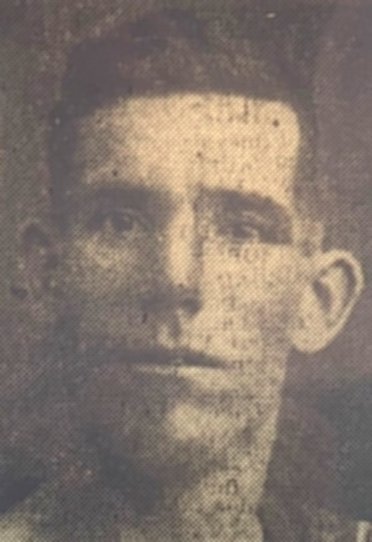
Image from the Oxford Mail, 29 April 1942.
William Marriott was the second of the four children of Joseph Marriott and his wife Lily (née Green). William and both his brothers served in the Second World War.
Joseph’s family were from the Bicester area, and as a young man he worked as a groom at the King’s Arms Hotel in Bicester. Lily was from St Ebbe’s in Oxford, the daughter of a (horse) cab driver. They married in Oxford in 1905 and set up home in Blackfriars Road, close to Lily’s family. Their first son Leonard was born soon afterwards. William was born on 9 May 1907, and both boys were baptised at Holy Trinity Church on 30 June. George was born in 1910, followed by Dora in 1911. By this time the children's father Joseph was working as a private coachman at a livery stable.
In the 1921 census the family was living at 28 Union Street, off the Cowley Road in East Oxford. Joseph was working as a garageman in the Randolph Hotel’s stable yard. Leonard was sixteen and employed as a porter in the warehouse at Ellison & Cavell, the large department store on Magdalen Street (later Debenhams). William was fourteen and, like his younger siblings, still at school.
All three Marriott brothers had military careers: they joined the reserves as boys, signed up for twelve years when they were eighteen, and rejoined just before the outbreak of the Second World War.
William joined the Royal Naval Reserve in 1922, aged fifteen. Records show that he was 5ft 5in tall, with auburn hair, hazel eyes and a fresh complexion. His occupation was as a stable boy; perhaps he worked with his father at the Randolph Hotel. Shortly after he turned eighteen, on 9 June 1925, he confirmed his commitment to the Royal Navy and signed up for twelve years full time. By this time he had grown to 5ft 7in and acquired a tattoo on each arm.
William was based at Devonport Royal Dockyard, Plymouth. Ships on which he served included Concord, Herald, Vindictive, Impregnable, Cleopatra, Vivid I, Valiant, and Norfolk. He won several awards for athletics, and his character was rated ‘Very Good’ at every review. His brother George’s military records show that their parents Lily and Joseph lived at 54 Walton Street in Jericho, and at 15 Lake Street in New Hinksey, in the mid-1920s and early 1930s.
In August 1937, having served in the Navy full time for twelve years, William signed up for the Royal Fleet Reserve (RFR), which comprised ex-Royal Navy men – older experienced sailors – who could be brought back into service for hostilities only, to make up any shortfall in Navy numbers. He was demobilised in October 1938, and recommended for a medal and gratuity (pension). He returned to Oxford and got a job at the Post Office sorting office in Becket Street. The electoral register for 1938 shows him living with his mother Lily at 100 Wytham Street in New Hinksey.
The 1939 register, taken on 29 September, four weeks after the Second World War broke out, shows Lily at 100 Wytham Street (and William’s sister Dora living with her husband John Savins next door at no. 102), but William was absent because he had already been called up and assigned to HMS Hermes. (His father Joseph seems to have returned to Bicester: the register shows him as a groom living at Bicester Hunt Stables near Stratton Audley House.)
HMS Hermes was the first ship to have been designed and built as an aircraft carrier, in 1924, but by the time of the Second World War she was largely outmoded, and unsuitable for carrying aircraft as she lacked capacity, speed and anti-aircraft equipment. She was therefore used for convoy defence and interception duties. In 1942 Hermes was deployed to the Indian Ocean. In April she was in port at Trincomalee in Ceylon (Sri Lanka) when warning was received that a large-scale Japanese air attack was planned. Hermes was sent out from harbour, as part of a strategy to disperse the British fleet in order to avoid providing one concentrated target for enemy planes. However, her one escort ship proved inadequate, and HMS Hermes was sunk by enemy fire about ten miles off-shore, on 9 April 1942, with the loss of 306 lives, including that of the captain RFJ Onslow. Later analysis suggested that had Hermes remained in harbour, she still would have sunk, but more lives could have been saved.
William Marriott was one of the wounded, and was probably picked up by the hospital ship which rescued most of the survivors. However, he died in hospital six days later of general peritonitis. He was 34. His death was reported in the Oxford Mail on 29 April 1942.
One of the survivors of the sinking of HMS Hermes was Joe Blewitt who went on to become a Lord Mayor of Oxford.
William Marriott was buried at Columbo (Kanatte) General Cemetery, Sri Lanka. The inscription on his gravestone reads: ‘Peacefully sleeping / Free from pain / In God’s good time / We shall meet again’.
Together with two other South Oxford men – Kenneth Cole and Maurice Goddard – William is remembered on the Oxford Post Office Second World War memorial which is in the sorting office on Oxpens, and in the General Post Office Book of Remembrance which is held by the Postal Museum in London.
William is also commemorated on the Oxford City Second World War Roll of Honour, which is in the church of St Michael at the Northgate on Cornmarket.
William’s father Joseph died in October 1942, six months after his son. William’s mother Lily continued living at 100 Wytham Street until her death in 1974. His sister Dora and her family moved to Woodstock. William's brothers – Leonard who served with the Royal Navy, and George who served in the Royal Tank Regiment in North Africa – survived the war, and returned to live in Oxford for the rest of their lives. George’s family lived in Cold Harbour for many years.
Research by Siobhan Lancaster; with thanks to Lesley Dewhurst.