Albert Henry HARRIS
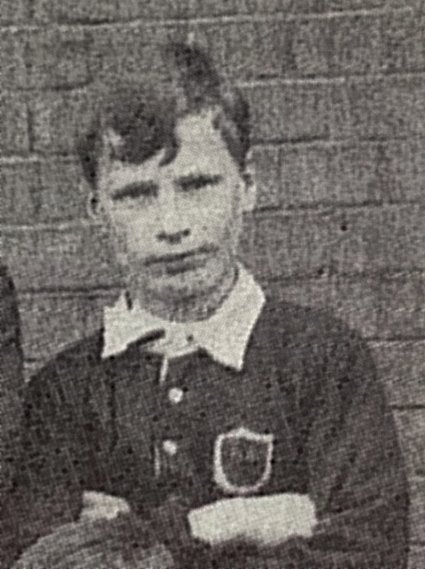
Albert Harris aged thirteen. Image from Carole Newbigging, The Changing Faces of New Hinksey and South Hinksey, Book 1 (Robert Boyd Publications, 1998).
Albert Harris was born in Ely, Cambridgeshire, on 18 October 1912. He was the son of Arthur Harris and his wife Eva (née Haynes). Arthur was a fishmonger whose ancestors came from Oxford; before her marriage Eva worked as a housemaid and later a cook. They had five children: Hector (born 1908); Arthur junior (1910); Jessie (1911); Albert (1912); and George (1914).
Arthur, Albert’s father, served with the Suffolk Regiment in the First World War.
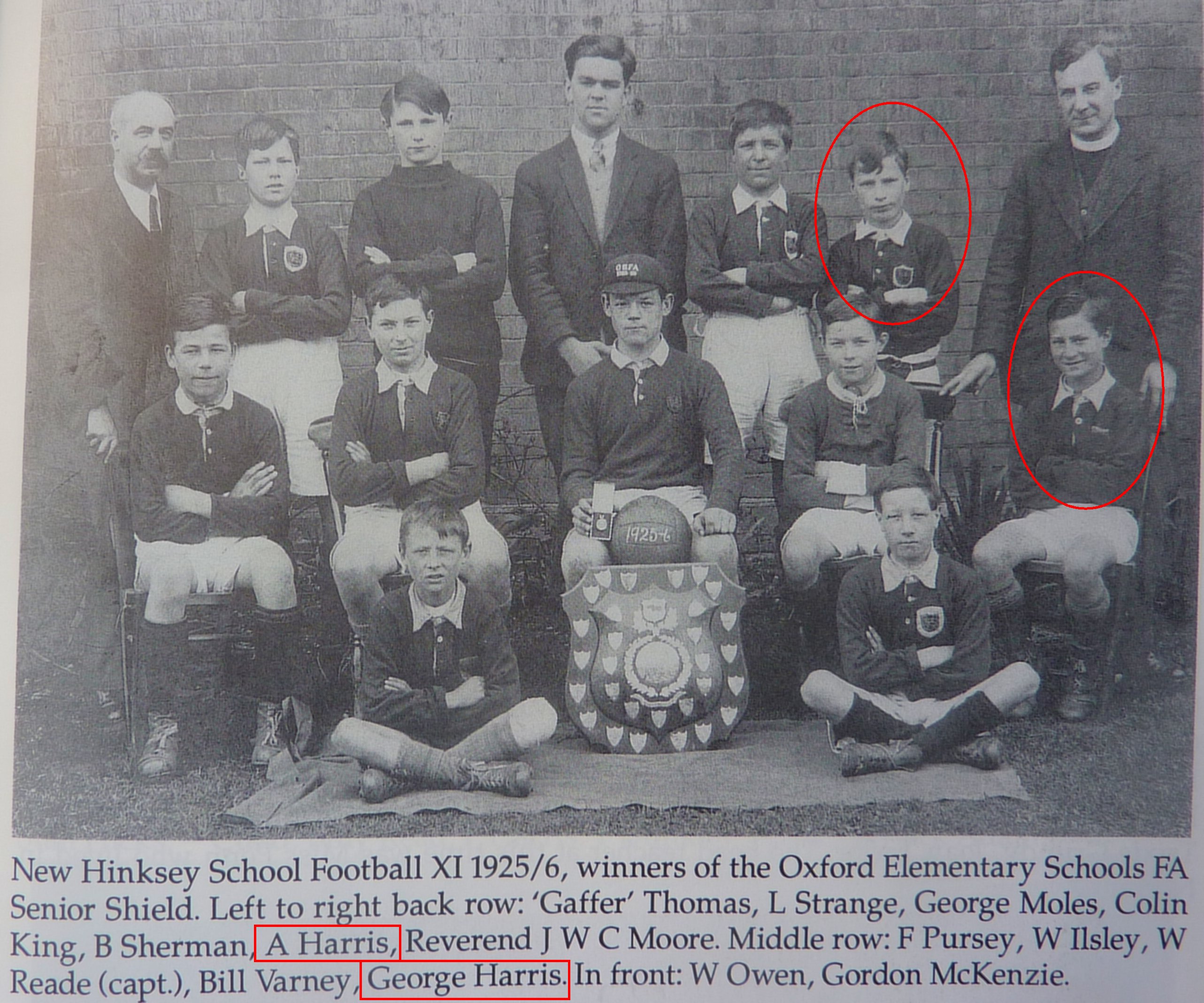
The Harris family was still living in Cambridgeshire at the beginning of 1923, but must have moved to Oxford shortly afterwards, as Albert attended New Hinksey School and won several prizes there, including a certificate in April 1923 during the Diocesan inspection of religious studies; the Bishop’s prize in 1925; and first prize for the school for his essay in the Education Office Trades Exhibition in 1927. In the 1925/26 season he and his younger brother George were members of the New Hinksey School Football XI which won the Oxford Elementary Schools FA Senior Shield.
After leaving school Albert joined the Royal Air Force and became a pilot with 41 Squadron. By June 1937 he was flying Hawker Demon biplanes from RAF Catterick in North Yorkshire. Albert married Violet Martin in July 1938, back in Oxford. Violet had been born in Toronto, Canada, but her parents came from Oxford, her mother from New Hinksey and her father from St Ebbe’s. By the time of the 1939 register, taken four weeks after the outbreak of the Second World War in September, Violet’s parents were living at 8 Monmouth Road, New Hinksey, and Albert’s parents were living nearby at 70 Sunningwell Road. Meanwhile Violet was living in Richmond, Yorkshire, near where Albert was stationed at RAF Catterick. Her sister Eleanor was living with her.
On 17 October 1939 – six weeks after the outbreak of war – Albert and two other pilots were involved in an operation off the coast near Whitby, attacking a Heinkel He 111H-1 aircraft which was believed to be targeting the Royal Navy’s battlecruiser HMS Hood. The attack resulted in the first downing of a German aircraft over British waters in the war, and the first victory for 41 Squadron. The two German airmen who survived (out of a crew of four) became the first German prisoners of the war.
The following day, Albert was killed when the plane he was travelling in as a passenger crashed soon after take-off. 41 Squadron was preparing to move from Catterick to Wick in Scotland. Airmen, equipment and ammunition were loaded onto a Whitley bomber, flown by a crew from 101 Squadron from nearby Driffield airfield. The plane had been overloaded with too much weight at the tail end; it took off and climbed to a height of around seventy feet, but stalled and crashed to the ground, igniting the ammunition on board. Albert and six other men died. It was Albert’s 27th birthday.
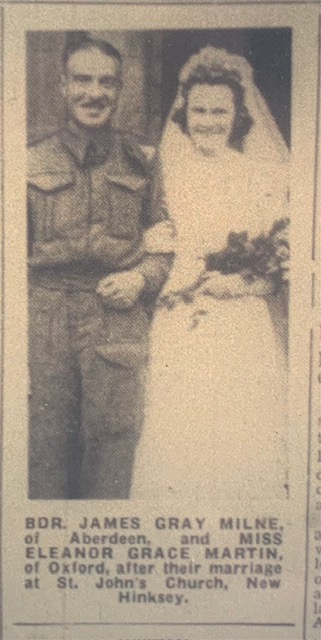
Albert and Violet’s daughter Eleanor Anne was born a few weeks later in Richmond, Yorkshire. Shortly afterwards, Violet moved back to New Hinksey, Oxford, together with her sister Eleanor, who had been living with her in Catterick, and after whom baby Eleanor Anne was probably named. In November 1940 Eleanor married Brigadier James Milne at St John the Evangelist in New Hinksey. Shipping records show Violet and Eleanor Anne crossing between Canada and Britain several times over the following ten years, and it seems that eventually the whole family moved back to Canada.
Albert was buried in the churchyard of St Laurence in South Hinksey. His headstone bears the inscription ‘In loving memory/of Albert/beloved husband/of Violet A Harris’. Albert is also commemorated on the Oxford City Second World War Roll of Honour which is in the church of St Michael at the Northgate on Cornmarket.
Albert was the first of our New Hinksey men to die in the war. He was also one of three who died shortly before their daughters were born, the others being James Lynes and Frederick Taylor.
Research by Siobhan Lancaster, with thanks to Lesley Dewhurst.
Albert Harris and his brother George in the New Hinksey School Football XI, 1925/6, when the team won the Oxford Elementary Schools FA Senior Shield. Image from Carole Newbigging, The Changing Faces of South Oxford and South Hinksey, Book 1 (Robert Boyd Publications, 1998). (Click image to close)
The marriage of Albert's sister-in-law Eleanor Martin (who was living with Albert's wife Violet at the time of his death) at St John the Evangelist Church, New Hinksey, as reported in the Oxford Mail, 6 November 1940. (Click image to close)