John Emerson BOYLE
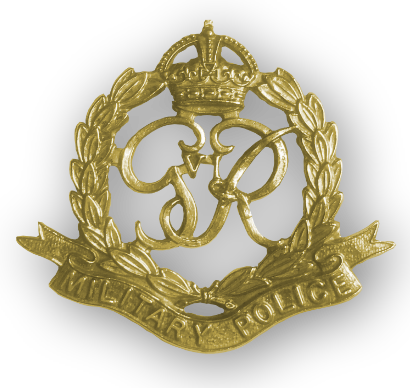
George VI Military Police cap badge (worn between 1936 and 1946); image courtesy of the Royal Military Police Association.
John Boyle does not seem to have lived in South Oxford himself, though his family had connections with the area. In the 1860s his great grandparents Jesse and Charlotte Dumbleton ran the Weirs Inn (also known as the University House) at Cold Harbour, and later his great grandmother ran the Farriers Arms at the far southern end of Abingdon Road. John’s grandparents and his mother Bessie Cooke lived briefly at 218 Marlborough Road, Grandpont in the early 1900s, when she was a teenager. The reason John is named on the memorial at St John the Evangelist is because he died here.
John’s parents William Boyle and Bessie Cooke were both living in Sidney Street in East Oxford when they married in 1908. William worked for the Great Western Railway, and over the previous decade had worked his way up from engine cleaner to 3rd, 2nd and then 1st class fireman. He started at Swindon station, and moved to Gloucester and then to Oxford, which is presumably where he met Bessie.
John was William and Bessie’s first child, born in September 1909 and baptised on Boxing Day at St Frideswide’s Church on the Botley Road. The family were living on ‘New Extension, Bridge Street’ (now Doyley Road), Osney Island, near the railway station. John’s brother Stanley was born in September 1912, by which time the family had moved to Earl Street, further along the Botley Road.
Soon afterwards, William was promoted to 3rd class engineman (train driver) at Swindon, and the family moved to Gloucestershire. He was badly injured whilst serving in the First World War. John’s two younger sisters Kathleen and Queenie were born in 1916 and 1920, when the family were living in Lechlade.
John Boyle became a gardener. In 1937, when he was 28, he was living at Mallards in Cholsey, South Oxfordshire, probably working for the Tollit family. In 1939 he was living at 26 Market Place, Brackley, on the Oxfordshire/Northamptonshire border, and working as head gardener at a school, almost certainly either Magdalen College School or Winchester House School in central Brackley.
John joined the Auxiliary Military Pioneer Corps on 28 November 1940 at the recruiting office in Reading. On 31 December the corps joined the 237 Company Pioneer Corps, which had been formed at Dovercourt in Essex the day before. The company moved to Colchester, to Aldeburgh in Suffolk, and then to Stowmarket. John was transferred to the Corps of Military Police in May 1941. He was in the Vulnerable Points Wing, a specialised branch which provided security for vital infrastructure such as ports, command headquarters and supply depots (and later for prisoner of war camps in western Europe).
John Boyle contracted pulmonary tuberculosis and was moved to Oxford, to the City Isolation Hospital at the far southern end of the Abingdon Road. The hospital cared for tuberculosis patients who were beyond hope of cure. He died there on 6 July 1942, aged 32. According to his death certificate, his younger brother Stanley was with him when he died; the address given for both was 66 Norreys Avenue, New Hinksey. (In the 1939 register this house was occupied by two families, the Bucks and the Earls, comprising fifteen people; perhaps Stanley was lodging there later in the war, whilst his brother was ill in hospital nearby.)
John was buried at St Laurence’s Church in South Hinksey; his Commonwealth War Graves headstone bears the inscription 'In loving memory / Of my beloved son / Thy will be done'. He is also commemorated on the Oxford City Second World War Roll of Honour which is in the church of St Michael at the Northgate on Cornmarket.
John’s father Willam Boyle died in Oxford in 1946 and is buried in Botley Cemetery; his mother Bessie died in Oxford in 1972.
Research by Siobhan Lancaster; with thanks to Lesley Dewhurst and to Paul Brown of the Royal Pioneer Corps Association.