(Frederick) Peter John ATKINS
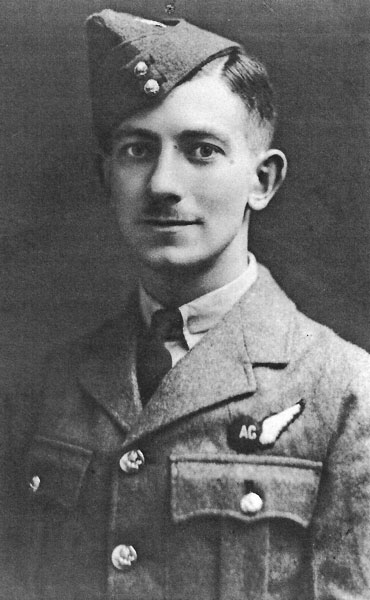
Image courtesy of John Moles, from the Battle of Britain Memorial website.
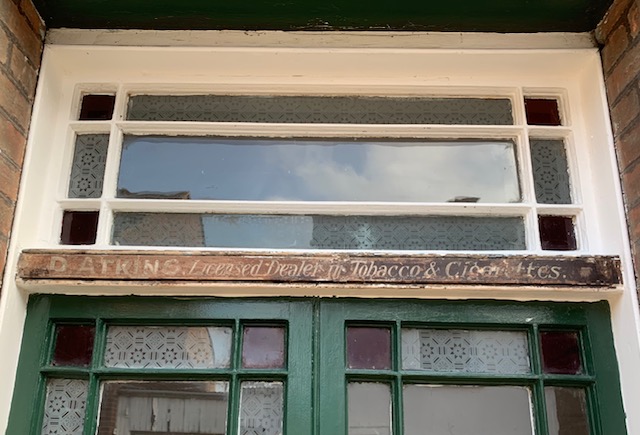
Frederick Peter John Atkins, known as Peter, was born on 29 June 1914, the son of Daniel and Eva Atkins. Daniel was from a family of bakers in New Hinksey. Eva (née Beesley) was from St Clement’s. She and Daniel married there in December 1909, and shortly afterwards moved to 62 Church Street (now Vicarage Road) in New Hinksey, where Daniel set up as a baker and grocer.
Daniel and Eva’s first child Ronald was born in September 1910, followed by Norah in 1912, and (Frederick) Peter in 1914. Daniel seems to have appeared before the military tribunal several times after the outbreak of the First World War, arguing for an exemption from conscription, but he was obliged to enlist in March 1917 and served for two years with the Ox & Bucks Light Infantry.
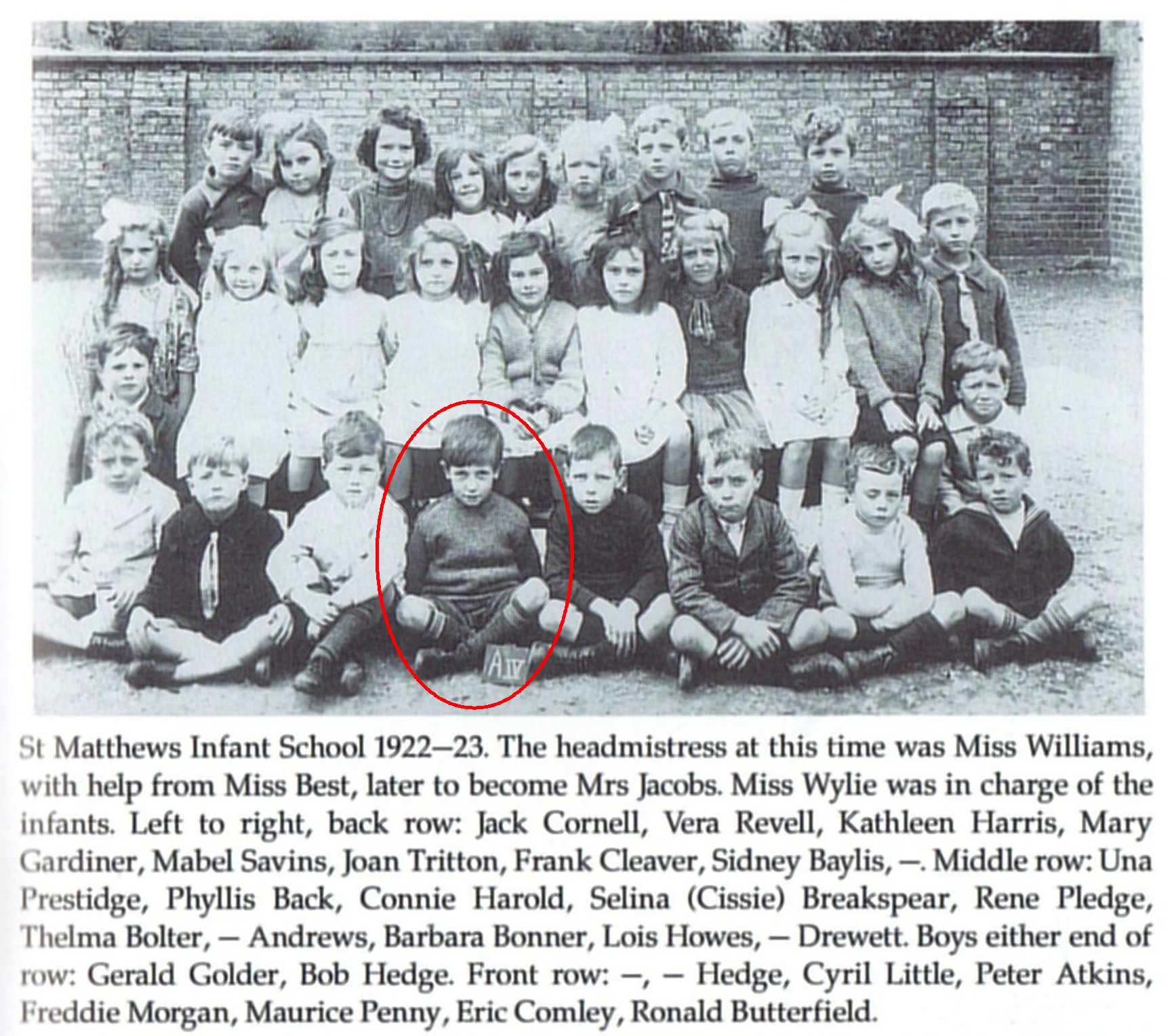
Peter (and probably his brother and sister as well) attended St Matthew’s Infant School on Marlborough Road in Grandpont, and in 1922-1923 Peter was in class AIV with Miss Wylie as his teacher.
Peter married Joyce Ethel Brinkhurst in April 1936, when he was 21. Joyce had been born in 1913 and baptised in Clapham, London. Her father Henry was a grocer at the time, but by the time of the 1921 census the family was living in Sussex and Henry was a postmaster. At some point in the 1920s the Brinkhurst family moved to Oxford.
Peter joined the Royal Air Force Volunteer Reserve on 19 August 1939 and trained as an Air Gunner, service no. 903401. In the 1939 register, taken four weeks after the outbreak of the Second World War in September, he and Joyce were living with her parents and her older sister Muriel at 4 Bartlemas Road in East Oxford. Joyce was working as a temporary clerk in the Ministry of Food, and Peter was a storekeeper at the motor works (almost certainly at Morris Motors in Cowley, where his father-in-law Henry Brinkhurst was a maintenance worker). Peter’s parents Daniel and Eva Atkins were still living at 62 Church Street in New Hinksey, and running the bakery and grocery business from there.
Peter was assigned to 141 Squadron in early July 1940, and stationed at Turnhouse in Edinburgh. The squadron was equipped with Defiant interceptor aircraft. These were designed to intercept bombers, and were effective against heavy aircraft, but were vulnerable to the more manoeuvrable German Messerschmitts. This was party because the position of the Defiant’s gun turret meant it could not fire forwards, and so it could be attacked from in front. Defiants were eventually withdrawn from use in daylight but were retained for night-time raids.
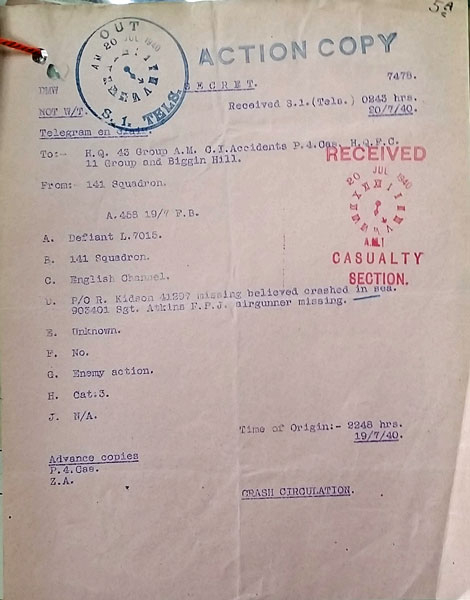
In mid-July 1940, 141 Squadron was sent to the Kent coast to participate in the Battle of Britain, the first major military campaign fought entirely by air forces, which lasted from 10 July until 31 October. On 19 July Peter Atkins’s plane, Defiant L7015, set off from near Dover with eight others to patrol the skies around Cap Gris Nez, between Calais and Boulogne. The squadron came under attack from Messerschmitts. Six aircraft and ten men were lost. Peter bailed out, but drowned; his body was washed up on the French coast. The plane crashed into the sea and the only other crewman, pilot Rudal Kidson (who was from New Zealand and aged 26), was also killed. Here is the telegram from 141 Squadron to RAF Biggin Hill reporting the two men missing.
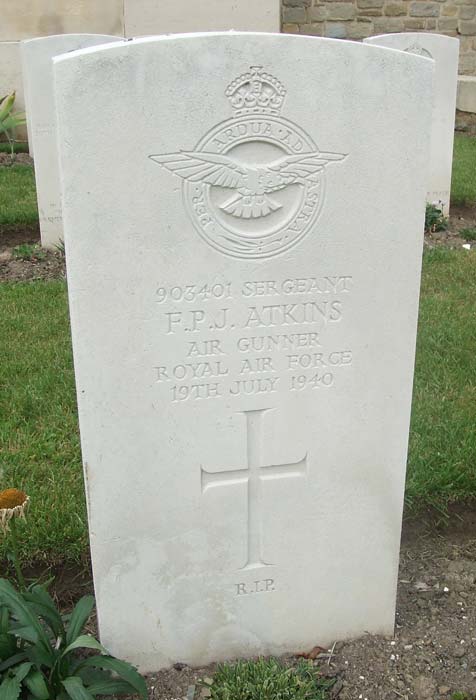
Peter was buried at Boulogne Eastern Cemetery in Pas de Calais, northern France; his gravestone carries the simple inscription ‘RIP’.
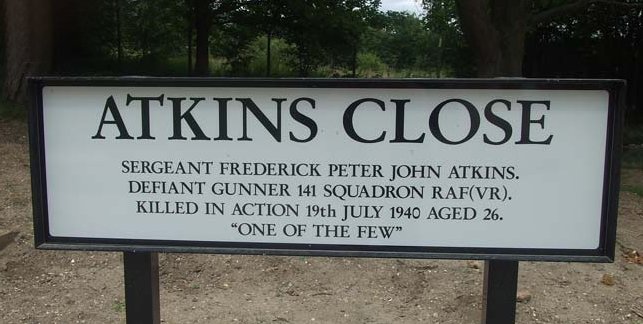
The memorial at St John the Evangelist in New Hinksey records Peter’s date of death as 16 July, but all other records give it as 19 July. He is also commemorated on the Battle of Britain Monument in London, on the Oxford City Second World War Roll of Honour, which is in the church of St Michael at the Northgate on Cornmarket, and in the name of Atkins Close at RAF Biggin Hill in Kent.
After the war Peter’s parents Daniel and Eva moved from Church Street to nearby Wytham Street in New Hinksey, and lived there until their deaths in 1962 and 1965 respectively. They are buried at Rose Hill Cemetery with their elder son Ronald who died in 1974.
Peter’s sister Nora married George Moles of 34 Newton Road, Grandpont, and in 2016 their son John Moles wrote an account of his uncle’s death for the Battle of Britain Monument website.
Peter’s widow Joyce married Claude Memess in 1944. She died in Norfolk in 2009, aged 95. Claude died in 2017, also aged 95.
Research by Siobhan Lancaster; with thanks to Lesley Dewhurst.
Daniel Atkins's name can still be seen above the door of the former bakery and grocer's shop at 62 Vicarage Road (formerly Church Street). (Click image to close)
Peter Atkins and his classmates at St Matthew's Infants School, 1922-23. Also in the class were Vera Revell, the sister of Leslie Revell, and Eric Comley, the brother of Dennis Comley; like Peter, Leslie and Dennis died in the Second World War. Image from The Changing Faces of South Oxford and South Hinksey, Book 2, by Carole Newbigging. (Click image to close)
The telegram sent by 141 Squadron to RAF Biggin Hill in Kent at 10:48pm on 19 July 1940 reporting that Pilot Rudal Kidson and Air Gunner Peter Atkins were missing. Image courtesy of John Moles, from the Battle of Britain Memorial website. (Click image to close)
Peter Atkins's Commonwealth War Grave in Boulogne Eastern Cemetery, Pas de Calais, northern France. Image courtesy of John Moles, from the Battle of Britain Memorial website. (Click image to close)
Atkins Close at RAF Biggin Hill in Kent. Image courtesy of John Moles, from the Battle of Britain Memorial website. (Click image to close)