James William LYNES
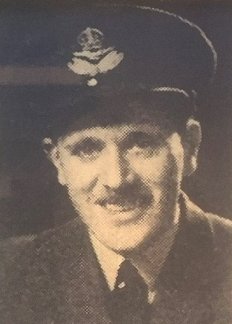
Image from the Oxford Mail, 31 December 1942.
James Lynes was the eldest child of Walter Lynes and Mary Saunders. Walter was a college servant, originally from Norfolk. Mary was from London, but like Walter she had been living in Oxford since her late teens. Walter had previously been married to Mary’s cousin, who died young in 1913. Mary moved in with Walter at 11 Sunningwell Road in New Hinksey, and James was born on 1 May 1914. His parents married the following year (Walter was 43 and Mary was 25), and had two more children: Margaret in 1915, and Charles in 1917.
At the time of the 1921 census Walter was employed at Trinity College and the family had an American boarding with them at 11 Sunningwell Road, Leonard Liddicoat from Sutter Creek, California, who worked at Oxford Town Hall as a cashier for the City Corporation.
James went to New Hinksey School, as did his younger brother and sister. He was recommended for a prize for religious studies during a Diocesan inspection, and a note in the headmaster’s logbook on 9 April 1925 says that James had qualified to sit for the Junior Schools examination. (There was an exam to qualify to sit the exam!) James passed and was awarded a scholarship to the prestigious City of Oxford High School for Boys, in George Street. He was there from the ages of eleven to sixteen, 1925 to 1930.
On leaving school James obtained a job in the City Treasurer’s office at the Town Hall. From 1935 he was also a member of the Observer Corps. This was a civil defence group made up largely of civilian volunteers who were trained to recognise and monitor aircraft. He was a member of No. 4 group which was set up in Oxford in March 1935.
By the time of the 1939 register, taken four weeks after the outbreak of the Second World War in September, the Lynes family had moved to 11 Oswestry Road. James’s father had retired, and his sister Margaret had married and moved to Cutteslowe. James (now aged 25) was recorded as a ‘Local Government Clerk’.
James joined the Royal Air Force Volunteer Reserve, and was assigned to 9 Squadron. This was the oldest bomber squadron of the RAF, and one of two Avro Lancaster squadrons specialising in heavy precision bombing. They flew Wellingtons and later Avro Lancasters, operating first out of RAF Honington in Suffolk and, from September 1942, out of RAF Waddington in Lincolnshire.
James married Margaret Lane, a bank clerk, in Salisbury in early 1941. Margaret lived with her parents on Henley Avenue, near the village of Iffley in Oxford.
In September 1942 James was promoted to Flying Officer (Navigator). On the evening of 20 December, James and his crew took off from RAF Waddington for Duisburg in the Ruhr Valley, Germany’s industrial heartland. Their plane was shot down by a night fighter over Den Hout, a village in Noord Brabant, in the southern Netherlands. All seven crew members died in the crash. James was 28.
James’s death was reported in the Oxford Times on 31 December 1942. His wife Margaret was expecting their first child; Elizabeth (Liz) was born five weeks later in January 1943. James was one of three New Hinksey men who died shortly before their daughters were born; the others were Albert Harris and Frederick Taylor.
James and hiis crew mates were buried near to where their plane crashed, at the Oosterhout Protestant Cemetery. He is remembered on the memorial to 22 City Corporation staff who died in the war, which is in Oxford Town Hall. He is also commemorated on the Oxford City Second World War Roll of Honour, which is in the church of St Michael at the Northgate on Cornmarket.
A commemoration service for former pupils of the City of Oxford High School for Boys was held at Christ Church Cathedral on 27 March 1947. James’s name is on the order of service with those of three other New Hinksey men: John Rowley, Frederick Taylor, and John Turner. All four are named on the school's war memorial.
James’s younger brother Charles served in the Royal Army Medical Corps during the war, before returning to New Hinksey. He lived at 252 Abingdon Road until his death in 1987.
James’s daughter Liz gives an insight into the long-lasting effects of the war: “My mother didn’t really talk a lot about him, I think it was her way of coping and moving on, and I didn’t like to ask too much for fear of upsetting her. After the war my mother married again to a lovely man who was fantastic to both of us. After they died, and with the advent of the internet, I have been able to discover much more, and we (my other half, and two grown-up children) have been to the Netherlands where my father and his companions are buried, to see for ourselves where their Lancaster came down, and to visit his grave. We met quite a few people whose older family members could remember seeing and hearing the crash. It made for quite an emotional visit and helped me to understand my mother’s reticence. My father’s life, for me, has been a bit like the pieces of a jigsaw puzzle, finding the correct bits, and finally getting a complete picture.”
Research by Siobhan Lancaster; with thanks to James Lynes's daughter Liz Lyon, and to Lesley Dewhurst.