Charles William WEBB
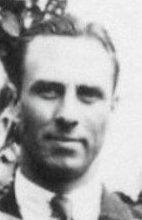
Image courtesy of Julian Webb.
Charles Webb’s name doesn’t appear on the memorial in St Matthew’s Church, but we feel that it should, as he lived in Grandpont and died whilst serving in the Second World War.
Charles William Webb was born in St Pancras in London on New Year's Day 1904. His parents were Charles and Eva (née Selby). Charles senior had been a Corporal in the Grenadiers before becoming a postman in the mid-1890s. He came originally from Kencot, near Carterton, West Oxfordshire, and Charles junior’s baptism took place in the Congregational Church in nearby Langford. Eva came from Leigh, near Cricklade, Wiltshire; as a young woman she worked as a live-in domestic servant in Kensington in London. Charles and Eva both had children from previous relationships: Charles had three sons by his first wife Mary, and Eva had an illegitimate son whose father was a Gloucestershire farmer, Alfred Selwyn. Mary died in 1901 aged 32, leaving Charles with three boys (George, Reg and Walter) under the age of seven. Charles and Eva married in St Pancras in April 1903, and Eva’s son Maurice (then aged five) joined the family. (Maurice was brought up as 'Fred Webb' and only discovered his true identity when he was in his forties, when he went to work for the Great Western Railway and had to ask his mother for his birth certificate.)
Charles junior was born in 1904, followed by Sydney (1905) and Henry (1907). In June 1909 Charles senior retired from the Post Office due to ill-heath. He was given a small pension for his fifteen years of service. Soon afterwards the Webb family moved from London to Alvescot, near Charles senior’s birthplace in West Oxfordshire. Here he found employment as a farm labourer (and subsequently as a carter), and a few years later they moved to nearby Broughton Poggs.
During the First World War Charles senior enlisted at the age of almost 50 (though he gave his age as 46) and became a Corporal with the Royal Engineers. He served in France from 1915 to 1916 but was discharged as medically unfit for war service. He was in France at the same time as his eldest son George, who served in the Ox & Bucks Light Infantry. George was wounded and gassed, but saw the war out. However, he never fully recovered, and died in 1949 aged 54. George's stepbrother Fred (Maurice Selwyn) also served in the First World War; he was invalided out with severe trench foot as a result of which he was permanently disabled. Here is a picture of George and Fred together before they went to war.
By 1921 Charles junior, now aged seventeen, was working as a gardener for the Hardcastle family at Broughton Hall near Broughton Poggs. His younger brother Sydney (fifteen) was a mason’s labourer for a builder in Filkins; and Henry (fourteen) was still at school. Charles’s four older half-brothers had all left home.
In November 1922 Charles joined the Ox & Bucks Light Infantry, service no. 5377164. He served for seven years, reaching the rank of Corporal, before being discharged in November 1929.
By October 1930 Charles had moved to Oxford and found employment as an under-porter at Corpus Christi College. Initially he lived in college; his salary was £2 a week (about £100 in today's money), with 5 shillings a week less during term time, when his meals were provided in college. His salary increased to £2 6s (less 5s for food during term time) from the end of October 1933. Here is a photograph of Charles and five of his brothers, taken in the 1930s.
On 9 April 1938 Charles married Frances King. Frances had been born in 1910 in Headington; she was the youngest of the three daughters of William King, an engineer, and his wife Maud (née Ayres). William’s mother – Frances’s grandmother – was Fanny Piddington, and through her Frances was related to Joseph Piddington. At the time of the 1911 census Frances and her family were living in Portslade-by-Sea near Brighton, but by 1921 they had returned to Oxford and settled at 82 Chilswell Road in Grandpont. Frances and her sister Doris were still at school, but their elder sister Violet (aged fifteen) was working as a part-time clerk for the famous Oxford provisions merchant Grimbly Hughes. Their father William King was a fitter’s mate for the Royal Engineers at Didcot. He died in 1935, aged 51.
Following Charles's marriage to Frances in 1938, he moved in with her family at 82 Chilswell Road. His mother Eva Webb died not long afterwards, aged 69, and was buried in St Peter’s churchyard in Filkins. His father Charles continued to live alone in Filkins until his own death in 1943, aged 77.
In April 1939, as Britain prepared for war, Charles joined the Territorial Army (the volunteer reserve force of the British Army). He re-entered the 4th Battalion of the Ox & Bucks Light Infantry. His army records describe him as 5ft 9in tall, weighing 144 lbs (10st 4lbs), and having a fresh complexion, grey eyes and brown hair. His religion was Church of England. He was called up for service on 25 August 1939 and, having already served with the regular army, he was promoted to Sergeant by April the following year.
In the 1939 register, taken on 29 September, four weeks after the outbreak of the Second World War, Charles’s wife Frances was recorded as living at 82 Chilswell Road and working as a retail grocer's ledger clerk, perhaps for Grimbly Hughes (like her older sister Violet). Living with her were her widowed mother Maud King; her sister Violet, who was employed as a wholesale grocer's stock book keeper (probably still for Grimbly Hughes); and a lodger, Albert Howard, who Violet would later marry. Albert worked for the Great Western Railway as a carriage and wagon examiner. Charles is not recorded in the 1939 register, having already left to rejoin the army, and the Corpus Christi list of college members for Michaelmas (autumn) term 1939 records him as 'Away on military service'.
After a period of training near Newbury, Charles and the 4th Battalion sailed from Southampton to Le Havre in northern France on 18 January 1940. Germany invaded on 10 May, and the fighting reached Charles and his battalion in mid-May, by which time they were stationed near the town of Cassel (about 60km south-east of Calais). Fierce fighting continued throughout May and into June – what became known as the Battle of France or the Western Campaign. The Dunkirk evacuation started on 26 May 1940, and the 4th Battalion, together with a number of other units from various regiments, was ordered to provide defensive rearguard action in an attempt to delay the advance of the German forces towards Dunkirk. Every day that the advance could be held back meant that more British troops could be sent back to England from the beaches (eventually more than 338,000 Allied soldiers were evacuated). The 4th Battalion was defending the strategic town of Cassel. The town was quickly surrounded by the enemy and the order was given to withdraw. The withdrawal was effected by small groups leaving separately and seeking to get to the Dunkirk perimeter. The casualty rate was high and only four members of the battalion are recorded as having reached England. Some two hundred wounded soldiers were left in Cassel, and most of the five hundred men who participated in the ‘breakout’ were captured by the Germans.
We don’t know exactly what happened to Charles Webb but it’s likely that he was amongst those captured. His War Office file records that he was reported missing in June 1940, and that in September 1940 his next of kin (his wife Frances) reported that he had been a prisoner of war, though in an unknown camp. In the Corpus Christi ledger which recorded his pension scheme contributions there is a hand-written note saying “Died as a prisoner of war 29 July 1940”. Webb family descendants have been told that Charles had both legs blown off and was captured, and then died in a German hospital.
According to his probate record, his War Office file, and his Commonwealth War Graves Commission record he died on 26 July 1940. He was 36. He was buried at Lille Southern Cemetery, 50km south-east of Cassel, though in Plot 2, not in Plot 3, which is where British prisoners of war were buried (and his name does not appear in the British Prisoners of War, 1939-1945 database on ancestry.co.uk).
The headstone on Charles's Commonwealth War Grave includes the inscription 'He lies and rests / With the brave / Of his young life, all / He gave for me & his country'. Charles is also commemorated on the Second World War memorial of his employer Corpus Christi College, and in the Second World War Book of Remembrance in the Regimental Chapel in Christ Church Cathedral in Oxford.
Charles left an estate worth £234 8s 9d (about £9,500 in today’s money) to his widow Frances. She also received the £111 9s which Charles had accumulated in his Corpus Christi pension fund over the course of his nine years of employment there. The War Office returned Charles's personal belongings to Frances in 1945; they comprised a pocket wallet, a watch in a case, a gold ring, souvenir notes, a purse, a note book, a paper of addresses, photographs, an identity disc, a fountain pen, a whistle, a pencil, and some souvenir coins.
Eighteen months after Charles’s death, Frances married Thomas Wilson, who earlier in the war had been living in Banbury and working as a toolroom labourer at the Northern Aluminium Company. They had two children: David born in 1948, and Frances in 1949.
Frances senior’s older sister Violet married Albert Howard in 1946 and the couple carried on living at 82 Chilswell Road with Violet’s mother Maud. Maud died in 1952, aged 66, and Albert less than two years later, aged 51. Violet continued to live in the house until her own death in 1986 at the age of 80.
Charles’s widow Frances died in November 1965 aged 55; she is buried in Wolvercote Cemetery.
Research by Mark Pear and Liz Woolley; with thanks to Julian Webb, great-nephew of Charles Webb (grandson of Charles's half-brother George); and to Harriet Patrick, Assistant Archivist, Corpus Christi College.
Back to the 24 Men of Grandpont and Cold Harbour 1939-45 biographies page
Six of the seven Webb brothers, 1930s. Left to right: Henry, Reg (Arthur Reginald), Charles, George, Sydney, Walter. (Fred Webb (Maurice Selwyn) is not in the photograph.) Image courtesy of Julian Webb. (Click image to close)
![[WEBB brothers, 1930s]](/images/photos/Local_history_section/Churches/St_Matz_WWII_war_memorial/WEBB_brothers_1930s_Julian_Webb._March_2026.jpg "WEBB brothers, 1930s")
George Webb (left) and his stepbrother Fred Webb (Maurice Selwyn), First World War. Image courtesy of Julian Webb. (Click image to close)
![[George Webb & Maurice Selwyn, WWI]](/images/photos/Local_history_section/Churches/St_Matz_WWII_war_memorial/WEBB_George_left_and_stepbrother_Maurice_Selwyn_right_Julian_Webb_March_2026.JPG "George WEbb & Maurice Selwyn, WWI")
Charles Webb (left) with an unknown fellow soldier, Ox & Bucks Light Infantry, probably in November 1922 when Charles joined the regiment, aged eighteen. Image courtesy of Julian Webb. (Click image to close)
![[Charles Webb (left), OBLI, c.1922]](/images/photos/Local_history_section/Churches/St_Matz_WWII_war_memorial/WEBB_Charles_on_left_Julian_Webb_March_2026.JPG "Charles Webb (left), OBLI, c.1922")
Joseph Edmund PIDDINGTON
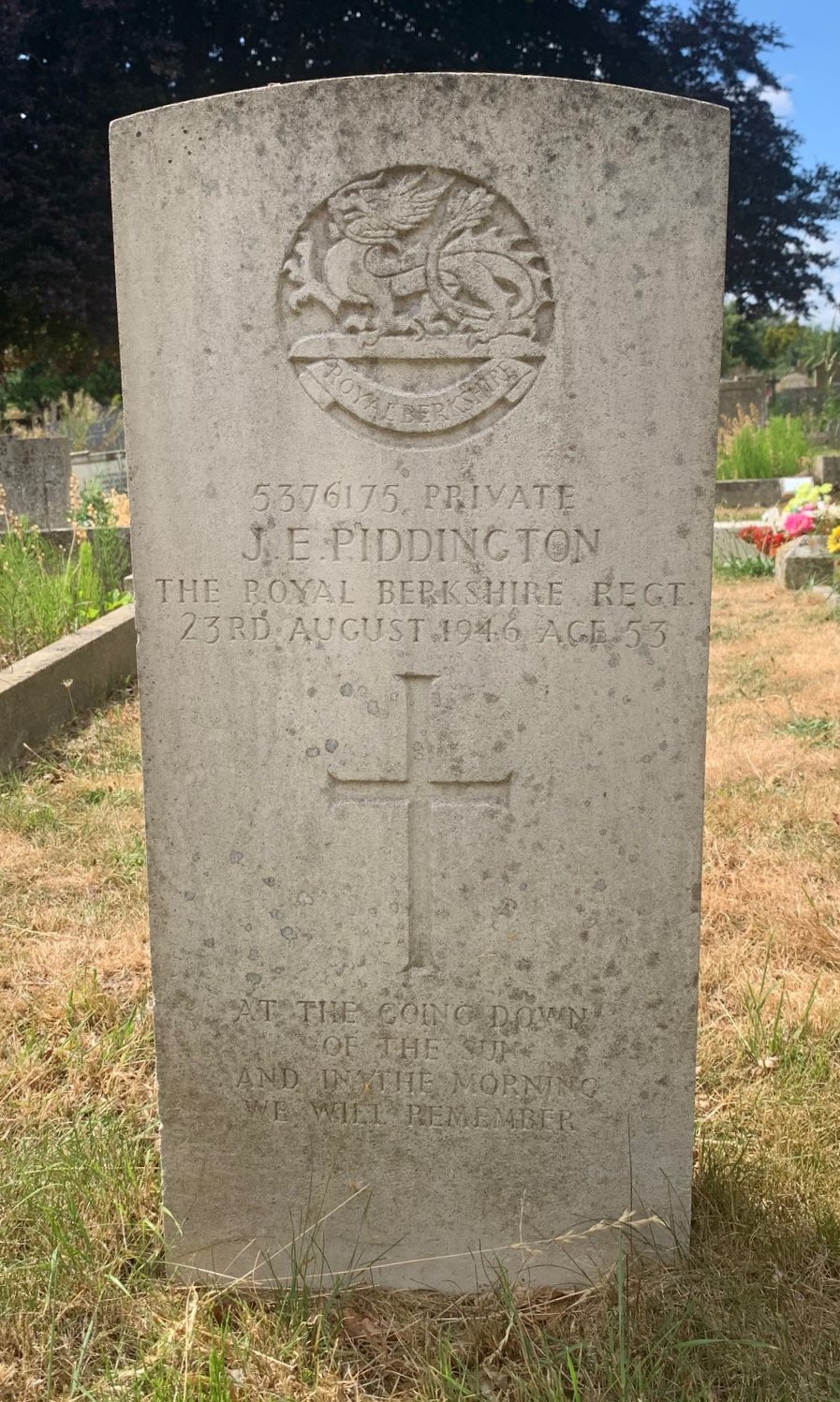
Joseph Piddington's Commonwealth War Grave in Wolvercote Cemetery. Image courtesy of Hark Hathaway.
Joseph Piddington’s name does not appear on the Second World War memorial in St Matthew’s Church, but we feel that it should. He lived in Marlborough Road in Grandpont, and spent most of his adult life in the Army Reserves or the Territorial Army. He served with the British Expeditionary Force in both world wars. Although he died at home fifteen months after the end of the Second World War, the fact that he has a Commonwealth War Grave at Wolvercote Cemetery means that he was considered to be a casualty of the war.
Joseph Edmund Piddington was born on 17 May 1893 in St Thomas’s, Oxford, and baptised in the church there on 8 June. He was the first son of Thomas and Sarah Piddington. The family lived in North Court off Hollybush Row, one of the many crowded courtyards which characterised this part of the city. Joseph’s father Thomas was a labourer, originally from Cuddington in Buckinghamshire; his mother Sarah (née Field) was from St Thomas’s, the daughter of a tailor. The family suffered bouts of financial hardship, and in 1890 Thomas was claiming poor relief from the Oxford Board of Guardians (an early form of state benefit).
Thomas and Sarah’s second son Thomas Charles was born in September 1894, by which time they had moved to Peacock’s Yard, a narrow courtyard off St Thomas’s High Street lined with back-to-back houses. A third son, William, was born in the winter of 1896, but died almost immediately, before he could be baptised.
By 1900 the family had again fallen on hard times and Joseph (now aged seven) was living temporarily in the workhouse on Cowley Road and being educated at the associated Poor Law School in Cowley. By 1901 however the Piddington family had moved to a slightly larger house in Bookbinder's Yard off St Thomas’s High Street (though they were sharing it with another couple). The 1901 census recorded Joseph at home there with his parents (his father an agricultural labourer and his mother a charwoman), and his younger brother Thomas, aged six.
In November 1910, aged seventeen, Joseph joined the Army Reserve E (Special Reservists), a unit formed in 1907 to create a pool of trained men who could reinforce the regular army in the event of war. Joseph signed up for six years with the Ox & Bucks Light Infantry; his attestation papers record that he was a news vendor, and had a tattoo on his left forearm.
The 1911 census records Joseph as a 'soldier (Private)' at home at 6 Bookbinder’s Yard with his parents and younger brother Thomas, who (like Joseph) was a news vendor. By 1913 the family had moved to 4 Chaundy’s Yard off Paradise Street in St Ebbe's, and in the winter of that year Joseph married Lizzie Blagrove. Lizzie was the daughter of a coal heaver and a laundress; she had grown up in St Thomas's, partly at 3 Bookbinder's Yard, three doors along from the Piddingtons. Lizzie moved in with Joseph at 4 Chaundy's Yard and their son Joseph Thomas was born there on 16 April 1914. The baby died twelve days later, after Joseph had taken him to bed and fallen asleep with him on his arm. The coroner's verdict was 'suffocation due to being accidentally overlaid'. Lizzie, Joseph's wife, died less than two weeks later; she was 21.
At the time of the deaths of his son and wife, Joseph was still serving with the Army Reserve whilst working as a news vendor. He was mobilised on 8 August 1914, shortly after the outbreak of the First World War. He was posted overseas as a Private with the 2nd Battalion of the Ox & Bucks Light Infantry, and spent some of the war in France as part of the British Expeditionary Force (BEF) and some of it back in Britain. (In 1915 he was in financial difficulties and claiming poor relief from the Oxford Board of Guardians.) In 1918 he became a Rifleman in the 33rd London Regiment (Reserve Battalion), and in early 1919 he was transferred to Class Z – meaning that he was released into civilian life but was obligated to return to service in the event of a national emergency. This obligation was abolished in March 1920, and Joseph was discharged from the army, having served for over eight years. As a survivor of the 1914 British Expeditionary Force, he was one of the Old Contemptibles.
During the First World War Joseph's younger brother Thomas served as a Private in the Ox & Bucks Light Infantry.
Two days before the end of the war, on 9 November 1918, Joseph married Caroline Hancock (known as Carrie) who was from Bicester, the daughter of a carpenter. She had been working as a live-in cook for the vicar of Hethe, near Bicester. Joseph’s mother Sarah died only a few months later, in March 1919, aged 46.
Joseph and Carrie moved to New Hinksey in South Oxford and their daughter Ruby was born on 18 April 1920. Joseph worked as a kitchen porter and re-joined the army reserves: in the 1921 census he was recorded as a Corporal in the 4th Battalion of the Ox & Bucks Defence Force, living with 170 other men at Vauxhall Camp, Didcot, whilst Carrie was at 1 Stewart Street, New Hinksey, with baby Ruby. Joseph’s widowed father Thomas was living alone at 94 Friars Street, St Ebbe’s, and had taken over the newspaper-vending business.
Joseph's brother Thomas junior, meanwhile, had gone to live in Jarrow on Tyneside, and had found employment at Palmers Shipbuilding and Iron Company. In 1920 he married Amy Willis who was from Fairford in Gloucestershire. They had three children, and later moved back to Gloucestershire, to Lechlade, where Thomas was employed as a storeman for the Air Ministry.
Joseph and Thomas’s father died in January 1927, aged 64. His death was recorded in the report of the Oxford Board of Guardians for that year, suggesting that he was receiving poor relief.
Joseph was discharged from the Army Reserves in 1926, but rejoined the Ox & Bucks (Territorial Army) in March 1931. His job at the time was as a tent repairer for the Royal Army Ordnance Corps (RAOC) at Didcot, and his army records describe him as being 5ft 5¼in tall, weighing 9 stone, and having a sallow complexion, hazel eyes and dark brown hair. His religion was Church of England.
In around 1936 Joseph, Carrie and their daughter Ruby moved to 163 Marlborough Road, Grandpont. In June of that year Ruby (now sixteen) got a job as a telephonist with the General Post Office on St Aldates. The 1939 register, taken on 29 September, four weeks after the outbreak of the Second World War, recorded her and her mother Carrie living at 163 Marlborough Road, Carrie undertaking ‘unpaid domestic duties’. Joseph (aged 46) was absent, having been called up for war service on 2 September.
Joseph was assigned to the 4th Battalion of the Ox & Bucks Light Infantry as a Private, service number 5376175. In January 1940 he was posted to France with the British Expeditionary Force. He returned to England in April, prior to the withdrawal of British forces to Dunkirk, during which the 4th Battalion suffered severe losses. Back at home, Joseph was transferred to the 8th (Home Defence) Battalion of the Royal Berkshire Regiment (Princess Charlotte of Wales’s). The main role of this battalion was to defend vulnerable points in the South Midlands, and later across the whole of southern England. In September 1941 he was discharged from the army as medically unfit, having been suffering from chest pains, shortness of breath, high blood pressure and rheumatism. Since 1931 he had served for a total of 12 years and 175 days (wartime service counting as double). His records state that his military conduct had been 'good' and that he was a 'clean and sober soldier’. In December 1945 he was awarded an army pension of 15 shillings a week (about £30 in today's money) plus a 'Disablement Award'.
Joseph died at home at 163 Marlborough Road on 23 August 1946, fifteen months after the war in Europe ended. His wife Carrie was with him; the causes of death were myocardial (heart muscle) degeneration and pulmonary tuberculosis. He was 53. He was buried at Wolvercote Cemetery. His Commonwealth War Grave, erected in 1949, is inscribed with words from Laurence Binyon’s poem For the Fallen, “At the going down / Of the sun / And in the morning / We will remember”. He left an estate worth £321 8s 4d (about £12,000 in today's money).
Joseph’s daughter Ruby had married Henry Hoare in the winter of 1942. Henry, a metal inspector at the Cowley car works, was born in London but seems to have been brought up by a couple called William and Elizabeth Beesley who lived at 137 Marlborough Road in Grandpont, Oxford. (Henry’s father had himself been the adopted son of the Beesleys.) Ruby and Henry’s sons Geoffrey and Peter were born in 1944 and 1946.
Joseph’s only sibling Thomas continued to live in Lechlade in Gloucestershire, but died in the Radcliffe Infirmary in Oxford in September 1953, aged 59.
Joseph’s widow Carrie lived at 163 Marlborough Road until at least the late 1960s. She moved to Marston, and died in 1981 aged 90. She was buried alongside Joseph in Wolvercote Cemetery.
Research by Mark Pear, Liz Woolley and Mark Hathaway.
Back to the 24 Men of Grandpont and Cold Harbour 1939-45 biographies page
Joseph Piddington's younger brother Thomas, Oxford Journal Illustrated, 13 December 1916. (Click image to close)
![[Thomas Piddington OJI 13-12-1916 p.6]](/images/photos/Local_history_section/Churches/St_Matz_WWII_war_memorial/PIDDINGTON_Thomas_OJI_13-12-1916_p6.jpg "Thomas Piddington OJI 13-12-1916 p.6")
Horace Amos BANNISTER
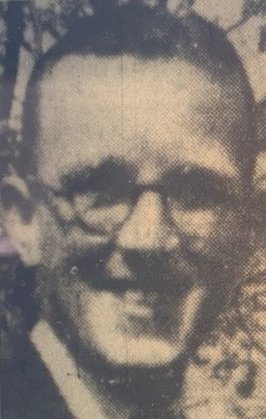
Image from the Oxford Mail, 17 February 1945.
Horace Bannister was born on 20 March 1915 in Radley (between Oxford and Abingdon), which was then in Berkshire. He was the son of a baker, Amos Bannister, and his wife Harriet (née Collett), a cook. Amos had been brought up in Headington near Oxford, the son of a farm labourer. Harriet was originally from Highworth, Wiltshire. They had both been widowed young; they married in June 1914, bringing their six surviving young children from their previous marriages to live together at Amos’s home, 32 Radley. (Radley was such a small village that there were no street addresses, only house numbers.) Their son Horace was born there in 1915.
Harriet’s daughter Daisy (Horace’s older step-sister) died in 1919, aged nineteen. In the 1921 census Harriet (aged 41) was recorded as the head of the household at 32 Radley, living with her daughter Lily Bolt (aged seventeen, a housemaid currently out of work); her step-son Aubrey Bannister (aged eighteen, a railway porter at GWR Colnbrook, west London); her step-daughter Muriel Bannister (aged thirteen); her step-son William (Bill) Bannister (aged ten); and her son Horace Bannister (aged six). Her other step-son Leslie Bannister (aged sixteen) was living with her sister in Swindon, employed as an apprentice at the Great Western Railway works there. Harriet's husband Amos – Horace’s father – appears to have been absent, possibly living in Sheffield and working for the wholesale bakery trade there.
By 1936, Horace’s parents – and possibly Horace too – moved to 39 Canning Crescent in Cold Harbour, at the far southern end of the Abingdon Road in Oxford. Amos was still working as a baker. In 1939 Amos and Harriet moved to 260 Marlborough Road in Grandpont, by which time all their children had left home. Horace (now aged 24) was lodging in Millers Green beside Gloucester Cathedral, and working as a shoe salesman. Early the following year he married Lillian Steer in her home town of Horsham in Sussex. Lillian was four years older than Horace and the daughter of an engineer. Prior to her marriage she had been living with her parents and working as a domestic servant.
Horace and Lillian had a daughter, Pauline, who was born in Oxford in early 1943 and died just a few weeks later.
At some point during the war, possibly in 1941, Horace enlisted as a Private with the 1st Battalion of the Ox & Bucks Light Infantry, service number 5389232. Lillian returned to Horsham to live with her parents at 3 Swindon Road.
In September 1944 Horace’s regiment moved from France into Belgium and thence into southern Holland. By January 1945 they were in the area around the town of Eindhoven. On 1 February they received orders for an attack into the Reichswald, across the border in Germany. The attack began on 8 February; the British met little opposition, and took many German prisoners, but in the evening heavy shelling of regimental headquarters wounded the doctor and caused considerable casualties among the intelligence section and signallers. It seems that Horace was injured during this attack; he was taken to the Allied hospital at the Marienbosch Monastery in Nijmegen, but died of wounds the next day, 9 February 1945. He was 29. The war ended three months later.
Horace's death was reported in the Oxford Mail on 17 February 1945. He was initially buried in the makeshift cemetery of the Marienbosch hospital, but was reburied at Jonkerbos War Cemetery, near Nijmegen, in April 1947. His Commonwealth War Grave headstone bears the inscription 'Sleep on beloved / And take your rest / We love you / But Jesus loved you best'. He is also commemorated in the Second World War Book of Remembrance in the Regimental Chapel in Christ Church Cathedral in Oxford.
In 2015 Horace’s was one of 40 names added to the war memorial in Horsham, following research by military historian Gary Cooper. You can read Gary's detailed description of the movements of the 1st Battalion of the Ox & Bucks Light Infantry in the period leading up to Horace's death here.
Horace left an estate worth £200 17s 7d (about £8,500 in today’s money) to his widow Lillian. She never remarried; she died in Horsham in April 2011, aged 100.
Horace's older half-brother Bill fought with the Royal Artillery during the war; on 15 March 1944 the Oxford Mail reported him as having been wounded in action in the Far East. He survived and returned to Oxford.
Horace’s father Amos died in 1949 aged 74; until shortly before his death he had been working at Back's bakery at 59 Marlborough Road, Grandpont. Horace's mother Harriet remained at 260 Marlborough Road for another ten years until she left, possibly to live with her daughter Lily. Harriet died in Oxford in 1966, aged 86, and was buried in Rose Hill Cemetery.
Research by Brenda Stones; with thanks to Horsham military historian Gary Cooper for additional information, and to Mark Hathaway for the photograph of the new panel on Horsham's war memorial.
Back to the 24 Men of Grandpont and Cold Harbour 1939-45 biographies page
Amos Bannister with his first wife Eliza, and their two oldest sons Leslie (born 1904) and Aubrey (born 1902), in Radley in around 1906. Image from the Evans-Bannister family tree, ancestry.co.uk. (Click on image to close)

Horace Bannister with his mother Harriet, c. 1920. Image from the Evans-Bannister family tree, ancestry.co.uk. (Click on image to close)

Kenneth Sidney AYRES

Ken Ayres (left) with his younger brother Gordon, in about 1940. Image courtesy of Steve Ayres.
Kenneth Ayres, known as Ken, was born on 23 November 1914 in Cold Harbour, at the far southern end of the Abingdon Road, Oxford. This area was still in Berkshire at the time. Ken’s parents were Frank and Elsie Ayres, who later ran the Farriers Arms pub. Frank came originally from Stadhampton, a village seven miles south-east of Oxford, but Elsie had been born and brought up in the pub. Her father Alfred Revell was a butcher as well as the licensee of the Farriers Arms, and had his shop on the other side of the road, slightly further west. Elsie’s mother Annie probably ran the pub whilst Alfred attended to his butchery business; by 1911, when she was sixteen, Elsie was working behind the bar.
Elsie and Frank married in May 1913 at St Laurence’s Church in South Hinksey, their first child Nellie having been born about six months earlier (and her birth registered in Wandsworth, London). Their next child Kenneth was born in November 1914, followed by Gordon in May 1920.
Elsie’s younger brother Frederick Revell was killed on 10 August 1918 at the Battle of the Somme, and is named on the First World War memorial in St Matthew’s Church.
In the 1921 census the Ayres family were living in Cold Harbour, near the Farriers Arms, which was still being run by Elsie’s parents. Frank was (unusually for a man) described as carrying out ‘home duties’. Nellie was eight, Ken was six, and Gordon was one. The children attended New Hinksey School on Church Street (now Vicarage Road). Here is a picture of Gordon at school in 1927.
Elsie’s mother Annie Revell died in 1924 and her father Alfred died in 1933. Thereafter Elsie and Frank moved to the Farriers Arms, her childhood home, and took over the running of the pub. Elsie can be seen in this picture of a coach outing from the pub in around 1937, and – later in life – working behind the bar here.
Ken’s older sister Nellie died in 1934 when she was 21, and was buried in the graveyard of St Laurence's Church in South Hinksey.
In early 1935, when he was twenty, Ken married Gladys Pitson. Gladys was eighteen and had been born and brought up in Sandford-on-Thames, where her father and grandfather worked in the paper mill. She was the youngest of seven children. Ken and Gladys had two sons, David (born in the autumn of 1935) and Patrick (known as Pat, born in the early summer of 1941). In the 1939 register, taken on 29 September, four weeks after the Second World War broke out, Ken and Gladys were recorded as living at 34 Lincoln Road (off the Abingdon Road). Ken was working as a lorry driver for Stephenson & Co, a large builders’ merchants on the Botley Road.
In 1939 or 1940, Ken joined the 1st Battalion of the Ox & Bucks Light Infantry as a Private, service number 5385925. His younger brother Gordon (who had previously worked as a clerk) joined the ground crew of the RAF and served in Burma and India, amongst other places.
In mid-June 1944 Ken’s battalion began moving from Faversham in Kent to the London Docks, to sail to Northern France to take part in the Normandy D-Day operations. The advanced party, the tracked vehicle party, and the marching troops reconvened at Bény-sur-Mer, 13km north of Caen, towards the end of June. From there they moved to the Le Haut du Bosq area. On 14 July the battalion received orders for an attack on the enemy-held hamlet of Cayer, south-west of Caen. The battle which followed resulted in over 170 British casualties – killed, wounded or missing. Ken Ayres survived that battle, but shortly afterwards the battalion was at nearby Bougy, under spasmodic fire from enemy artillery and mortars. Ken was probably killed in one of those attacks; he died on 3 August 1944, aged 29. His death was reported in the Oxford Mail on 16 August.
Ken was buried at Ranville War Cemetery, 10km north-east of Caen. His gravestone carries the inscription 'Deep in our hearts / A memory is kept / Of one we loved / And will never forget.'
Ken’s nephew Steve Ayres (son of Ken’s younger brother Gordon) has two letters, one which Ken sent to Gordon when he was staying in a convalescent home for wounded servicemen near Sevenoaks, Kent. In it Ken says "Well Gorden I am feeling fine now I managed to work myself to the above address [Combe Bank Convalescent Home] it is a lovely place just like Buckingham Palace the food is lovely they wait on you like servants don't get up until 8am, this is the life Gordon why not try it some time you even get 30 fags a week free although we only get 7s/6d a week."
The other letter is from Ken and Gordon's father Frank to Gordon in India, dated 21 August 1944, telling him that Ken had been killed. He wrote more than a page of chatty news before saying: "Well Gordon I expect you are surprised me writing to you but I have some bad news for you we have heard from the War Office that Ken was killed in France. You must bear up Gordon and look after yourself so that you can come back to us. I suppose it was to be I still can't believe it is true he was always so confident about himself your mother is bearing up very well so I hope you will write to her as often as you can as it was a great shock to us. Gladys is also bearing up well I hope you will write to her, also she is going to stop with us. David is getting quite a big boy you will see a difference when you see him also little Pat he is such a nice little boy he is just beginning to talk."
Ken is remembered on the war memorials of all three churches in South Oxford: St Matthew’s, St Luke's in Cold Harbour, and St John the Evangelist in New Hinksey (as is another of our 24 Men of Grandpont and Cold Harbour, Reginald Collins). Ken was the cousin of Leslie Revell, who is also named on the St John the Evangelist memorial. (Ken’s mother Elsie and Leslie’s father John were brother and sister.)
Ken is also commemorated on the Oxford City Second World War Roll of Honour, which is in the church of St Michael at the Northgate on Cornmarket, and in the Second World War Book of Remembrance in the Regimental Chapel in Christ Church Cathedral. His name (together with that of another of our 24 men, William Hedges) is inscribed on the British Normandy Memorial in northern France, which commemorates the 22,442 servicemen and women under British command who died on D-Day and during the Battle of Normandy in the summer of 1944.
After the war, in early 1946, Ken’s widow Gladys married her cousin Dennis Hayes. Dennis had been born in Taunton in Somerset, but his mother Matilda Naish and Gladys’s mother Kate Naish were sisters, and had grown up in the cottage adjacent to the paper mill in Sandford-on-Thames, where their father worked. Gladys and Dennis took David and Pat (aged nine and three when their father died) to live in Dennis's home town of Taunton; Gladys died there in 2005, aged 88.
Ken’s brother Gordon married Meriel Thomson (née Pyke) in 1948. Meriel came from Summertown and had worked as an office clerk during the war. In early 1944 she had married an Australian airman, David Thomson, but he had been killed only a few months later, serving with the Australian RAF in France. Their daughter Nadene was born the following summer. Meriel and Gordon later took over the running of the Farriers Arms, the third generation of the Ayres family to do so; their son Steve was born in 1960.
Ken and Gordon’s father Frank died in 1953, aged 61. Three years later their mother Elsie married William Brooks, a retired master builder; she was 69 and he was 74. She died in 1977.
Research by Brenda Stones; with thanks to Steve Ayres, nephew of Ken Ayres.
Back to the 24 Men of Grandpont and Cold Harbour 1939-45 biographies page
A coach outing from the Farriers Arms, c. 1937. Image from The Changing Faces of South Oxford and South Hinksey, Book 1, by Carole Newbigging. (Click image to close)

Gordon Ayres and his classmates at New Hinksey School, 1927. Image from The Changing Faces of South Oxford and South Hinksey, Book 1, by Carole Newbigging. (Click image to close)

Landlady Elsie Ayres working behind the bar of the Farriers Arms. Image courtesy of Steve Ayres. (Click image to close)

Ken and Gladys Ayres in 1940, being weighed and having their picture taken at the same time on a Photoweight machine. Image courtesy of Steve Ayres. (Click image to close)

Gordon Ayres (right) with his friend Gilbert Harris at the Farriers Arms. Image courtesy of Steve Ayres. (Click image to close)

Ken's father Frank Ayres. Image courtesy of Steve Ayres. (Click image to close)

Edward George BOSWELL
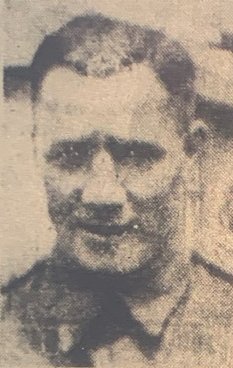
Image from the Oxford Mail, 28 April 1943.
Edward Boswell, known as Ted, was born on 4 March 1914 in St Aldates in Oxford. His father Ernest was born in Garsington, five miles south-east of Oxford, but brought up in St Ebbe’s. He worked as a carter for the City Corporation. Ted’s mother Harriet (née Butler) was brought up in Shepperd’s Row off St Aldates, the daughter of a brewer’s carter. As a young woman she worked as a domestic servant. She and Ernest married in 1912 and Ted was the second of their seven children. Ernest served with the Machine Gun Corps during the First World War.
In 1921 Ted (aged seven) was living in Burrow's Yard – one of the many narrow courtyards off St Aldates – with his parents and four brothers: Ernest (aged eight); William (three); Reginald (one); and Vincent (six months). A fifth brother, Dennis, was born in 1922, followed by Frederick in 1924 and a sister, Joan, in May 1927. By this time the family had moved to Weirs Lane in Cold Harbour, at the far southern end of the Abingdon Road, part of a new council estate built to rehouse families displaced by clearances in St Aldates.
Ted’s younger brother Dennis died at the age of five in August 1927, followed only a few months later by their father Ernest, who was 44. Reginald died the following year, aged eight. Ted’s mother Harriet had another child, Margaret, in 1931, though it’s not clear who the father was; she was given the surname Boswell.
Ted and his brother William (Bill) were both keen footballers and played for the Cold Harbour club. In the early summer of 1935, when he was 21, Ted married Dorothy Chandler, who was 22. She grew up in New Hinksey in South Oxford, the youngest of ten children. Dorothy’s father William was a plumber and painter; he and three of Dorothy's brothers served in the First World War. Two of them – William and George – were killed and are commemorated on the war memorial in the church of St John the Evangelist in New Hinksey. Dorothy’s mother Alice died in 1923, when Dorothy was ten.
Following their marriage, Ted moved in to Dorothy’s family home at 28 Gordon Street in New Hinksey with her widowed father William. Ted and Dorothy’s first child Sheila was born in November 1935.
Ted’s older brother Ernest died in the summer of 1937, aged 24. His mother Harriet remarried that autumn, to a former seaman called Albert Savins. Another of Ted’s brothers, Vincent, died in 1938 at the age of seventeen, meaning that four of his six siblings had died young.
Ted and Dorothy’s second child Janet was born in March 1938. The 1939 register, taken on 29 September, four weeks after the outbreak of war, recorded Ted and Dorothy living at 28 Gordon Street, New Hinksey, with their daughters Sheila and Janet, and Dorothy’s father William. Ted was working as a motor driver, test-driving newly-built cars at Morris Motors in Cowley.
Ted and Dorothy’s third child William (known as Bill) was born in 1940. It’s likely that Ted joined the 144th Battery of the 35th Light Anti-Aircraft Regiment, Royal Artillery (a Territorial unit formed at Oxford specifically for the defence of RAF airfields) around this time. He was a Gunner, service number 1523727. The initial work of the regiment was to defend Oxfordshire, and later other southern counties, against air attack. In November 1941 however, the regiment set sail from Greenock in Scotland. When Ted left the country, Dorothy was pregnant with their fourth child.
The intended destination of Ted’s regiment was the Middle East, but they were diverted to Singapore, reaching there in January 1942. Between 8 and 15 February there was intense fighting between British and Japanese forces, resulting in Japan capturing Singapore (said to have been the largest British surrender in history). About 80,000 British, Indian, Australian and local troops became prisoners of war, including Ted Boswell. He was reported missing soon afterwards.
Back at home in Oxford, Dorothy gave birth to a son, Roy, in May 1942, but the baby died when he was only a week old. By now the family had moved to Radcliffe Road off the Iffley Road in East Oxford, and Roy was buried in nearby Rose Hill Cemetery.
On 18 October 1942, Ted was among six hundred men of the Royal Artillery who were transported by the Japanese from Singapore to Rabaul in Papua New Guinea. At the end of November, 517 of those men (including Ted) sailed from Rabaul to Ballalae, one of the Solomon Islands, leaving behind 82 of their colleagues, most of whom were considered too sick to make the journey. Only 18 of those 82 survived to the end of the war. Those taken to Ballalae were forced to construct an airstrip for the Japanese that is still in use today. None of these 517 men survived. Approximately one hundred died from overwork, exhaustion and tropical diseases, and about three hundred were killed by an allied air raid on the island. After completing the runway, the remaining prisoners – including Ted Boswell – were executed and their bodies thrown into mass graves. Another of our 24 Men of Grandpont and Cold Harbour, Ernest Finch, was also one of the victims. The official date given for what became known as the Ballalae Massacre was 5 March 1943, but it is generally accepted that it probably occurred in late June. On 28 April the Oxford Mail reported that Ted was a prisoner of the Japanese.
Ted was 29 when he died. He, Ernest Finch, and the other victims of the massacre are commemorated on the Singapore Memorial in the Kranji War Cemetery, which bears the names of over 24,000 casualties of the Commonwealth land, sea and air forces who have no known grave. Ted's name is inscribed on Column 13. Another of our 24 Men of Grandpont and Cold Harbour, Alan Martin, is also listed on the memorial. Ted is also remembered on the war memorial of St Luke's in Cold Harbour, South Oxford.
Ted’s widow Dorothy married Stanley Ledwell in the autumn of 1946. Stanley had been brought up in St Ebbe’s, where his father was employed at the gas works; as a young man he had lived in Canada. He died in 1960 at the age of 54. Dorothy died in 1995, aged 72.
Ted and Dorothy’s oldest child Sheila married Gordon Mazey in 1955; her younger sister Janet married Ivor Foley in 1957. At the time of writing (2025) their younger brother Bill is still alive and living in Oxford.
In 2003, Bill and his nephew Chris Foley (son of Janet and Ivor) joined other members of the charity COFEPOW (Children of Far East Prisoners of War) in a pilgrimage to Ballalae in the Solomon Islands. There they laid a plaque to commemorate their relatives, the prisoners of war who had died on the island 60 years before.
Research by Mark Hathaway and Brenda Stones; with thanks to Andrew and Brenda Wee for the photograph of Ted's name on the Singapore Memorial.
Back to the 24 Men of Grandpont and Cold Harbour 1939-45 biographies page
Ted Boswell and his younger brother Bill in the Cold Harbour Football team, c. 1934-5. Image from The Changing Faces of South Oxford and South Hinksey, Book 1, p.92. (Click image to close)
![[BOSWELL Ted, Cold Harbour Football team 1934-5]](/images/photos/Local_history_section/Churches/St_Matz_WWII_war_memorial/BOSWELL_Ted_Cold_Harbour_Football_Club_1934-5_Changing_Faces_Bk_1_p.92.jpg "BOSWELL Ted, Cold Harbour Football team 1934-5")