Albert Edward OLIVER
![[Oliver AE OJI 13-02-1918 p.6]](/images/photos/Local_history_section/Churches/St_Matz_war_memorial/Oliver_AE_OJI_13-02-1918_p.6.jpg "Oliver AE OJI 13-02-1918 p.6")
Image from the Oxford Journal Illustrated, 13 February 1918, p.6. Pte AE Oliver had gone missing nine months earlier and was now presumed dead.
Albert Oliver's wife lived in Headington and so he also appears on the war memorial of All Saints church, Highfield and some of the information below comes from their website.
Albert Oliver was born in Oxford on 19 June of 1887, the only child of Edward Oliver (born in Newcastle upon Tyne in 1864) and Mary Ann (née Day, born in Childrey, then in Berkshire, in 1864/5). He was baptised at St Aldates church on 7 August. His parents had been married in the spring of 1886; Albert’s father was a boatman or boatbuilder. At the time of the 1891 census the family were living at 31 Thames Street (off St Aldates) and Albert was aged three. By 1901, when Albert was 13, his father was a boatman on a barge, and the family spent census night at Bourne End, Buckinghamshire. By 1911 the family was living at 2 Jubilee Terrace, Grandpont, and Albert (now 23) was also working as a boatbuilder, possibly at the oar and scull works of Harris & Son, which was next door to the house. The proprietor, George Harris, was himself living at 2 Jubilee Terrace by 1915.
On 5 June 1915 Albert married Martha Lammas (born in St Ebbe’s in 1887) in All Saints’ Church, Headington. By this time he had already volunteered to serve as a Private with the 5th Battalion of the Oxf & Bucks Light Infantry (service no. 32709) and his address at the time of his marriage was given as Great Waltham, near Chelmsford in Essex, where the Oxf & Bucks were then stationed (see Arthur Belcher). The 5th Battalion had formed at Oxford in August 1914 in response to Lord Kitchener's call for 100,000 volunteers to join the army soon after War broke out. The battalion landed at Boulogne in May 1915 and moved to the Somme on 7 August 1916.
It's likely that following her marriage to Albert in 1915, Martha remained in her parents’ house at 17 New High Street in Headington while Albert was away. She had a son, Stanley Albert, born in New High Street, Headington, and baptised at All Saints’ Church on 21 September 1916. Albert is described as a boatbuilder at the time of the baptism, so it is possible that he left the army after his marriage; but he would have been conscripted back in the following year.
Albert was killed on 3 May 1917, aged 29, during the Third Scarpe phase of the Battles of Arras. The British were supporting a larger French offensive further south - the battles of the Chemin des Dames and the Champagne Hills. Percival Edens and Albert Smith were killed in the same battle on the same day. Their bodies were never recovered but all three are named on the Arras Memorial at Pas de Calais, which commemorates almost 35,000 servicemen from the United Kingdom, South Africa and New Zealand who died in the Arras sector between the spring of 1916 and 7 August 1918 (the eve of the Advance to Victory) and who have no known grave.
Albert's son Stanley was eight months old when his father died. He and his mother Martha continued to live with his grandparents at 17 New High Street, Headington, and Albert is therefore also remembered on the Roll of Honour of All Saints’ Church, Lime Walk. Martha remained at 17 New High Street after her parents' deaths and until at least 1976. Her and Albert's son Stanley married Doris Webster in the Ploughley Registration District in early 1944.
With thanks to Stephanie Jenkins for additional information.
Percy Arthur PALMER
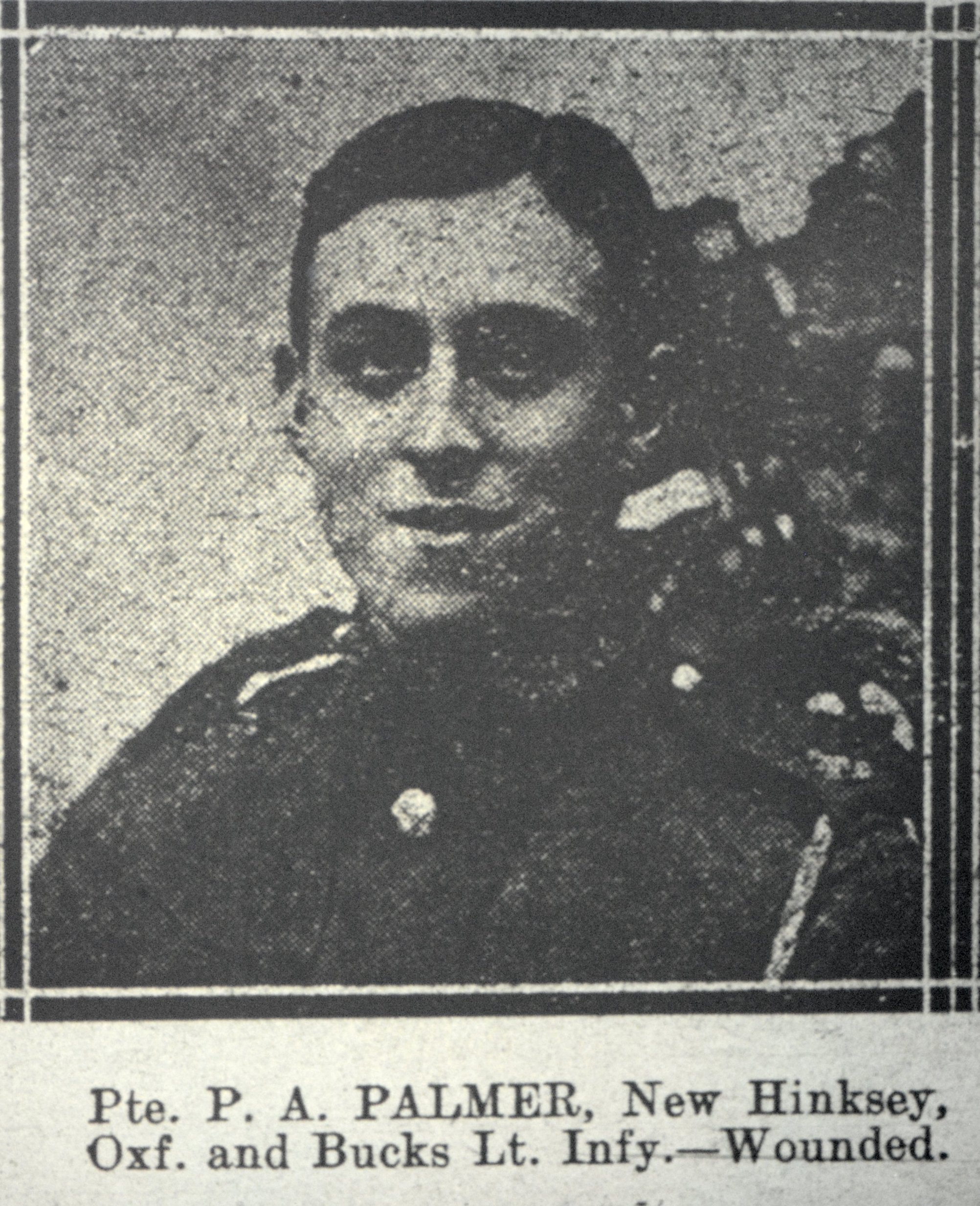
Image from the Oxford Journal Illustrated, 20 September 1916, p.7. It says that Pte Palmer was 'Wounded' when in fact he had been killed.
Percy Palmer was born in Oxford in early 1896, the elder son of Walter and Ada Palmer. His father had been born in Kennington in 1862/3 and was a boat carman with Salter's Steamers, the boat-building and hire firm based at Folly Bridge. He had previously worked as a blacksmith. Ada had been born in Oakley, 14 miles north-east of Oxford, in 1870/71. The couple married in 1894/95 and lived at 192 Abingdon Road before moving to a newly-built house, 17 Sunningwell Road, in 1907.
Before the War Percy worked as a messenger for the fever hospital at Cold Harbour, at the southern end of the Abingdon Road. He was a keen footballer and played for the Oxford Boys XI and later the Oxford Wanderers Football Club. He had a brother, Cyril Bernard, who was a year younger than him and who worked as a picture framer's assistant. Both brothers joined the army; Percy enlisted as a Private with the 1/4 Battalion of the Oxf & Bucks Light Infantry (service no. 200290) and Cyril with the Mechanical Transport Company of the Army Service Corps (service no. 279922).
Percy's battalion was sent to the Somme and he was killed in action on 23 July 1916, aged 21, at the Battle of Pozieres. Richard Cherrill, William Ingram, Harry Saunders and Arthur Whiteley were all killed in the same battle on the same day. Pozieres was a village in the German second line and was captured only after an epic struggle on 23 July by a joint British-Australian assault. The fighting around the village and beyond continued for many weeks afterwards.
Percy's body was never recovered but he is commemorated on the Thiepval Memorial. This is the memorial to the Missing of the Somme, which bears the names of more than 72,000 officers and men of the United Kingdom and South African forces who died in the Somme sector and have no known grave. Percy is also named on the World War I memorial in the church of St John the Evangelist, New Hinksey.
Percy's brother Cyril survived the War.
Arthur George PHIPPS
![[Phipps AG Osney cemetery smaller]](/images/photos/Local_history_section/Churches/St_Matz_war_memorial/Phipps_AG_Osney_cemetery_smaller.JPG "Phipps AG Osney cemetery smaller")
Arthur Phipps's grave in Osney Cemetery in West Oxford; image courtesy of Anne Kiltie.
Arthur Phipps was the nephew of Walter Phipps. He was born in December 1899 and baptised at St Aldates church the following February. He was the only child of Arthur Phipps, a bricklayer, who had been born in St Ebbe's in 1868/69 [he was the brother of Walter Phipps]. Arthur's mother Annie (née Putt), had been born in Islington in 1867/68, the daughter of a bootmaker. By the time of her marriage to Arthur senior, at St Matthew's church in Grandpont in March 1894, she was living in Marlborough Road. The couple moved to 50 Chilswell Road and Arthur junior was born there in 1899; by 1911 the family had moved to 86 Chilswell Road.
The Phipps were well-known local builders and various members of the extended family built many of the new houses on the Grandpont estate in the 1880s, 1890s and early 20th century. However, by April 1911, when the census was taken, Arthur's father was 'too ill to work' and he died the following September, aged only 43, when Arthur was 12. His funeral was at St Aldates church and he was buried with his sister and parents at Osney Cemetery.
Arthur junior did not turn 18 until December 1917 so he could not, in theory, have enlisted before then. He became a Private with the 10th Battalion of the Royal Warwickshire Regiment, service no. 260385. He must have spent some time overseas as he was postumously awarded the British War and Victory medals for his military service. However, on his return to England he died of Spanish influenza on 12 April 1919, aged 19, at the Endell Street military hospital in Covent Garden in London. This had been opened in May 1915 by militant suffragists Dr Flora Murray and Dr Louisa Garrett Anderson. It was the first military hospital to be run and staffed entirely by women.
Arthur's body was brought back to Oxford and his funeral was at St Aldates church on 17 April 1919. He was buried near his father and other members of his family in Osney Cemetery. ‘A loved one sleeps’ was carved on his headstone at the request of his widowed mother.
Arthur's mother Annie remained living in Chilswell Road for the rest of her life; she died in May 1937, aged 69, and her funeral was at St Matthew's church.
With thanks to Barry Burnham for additional information; his full biography of Arthur Phipps appears here.
Walter James PHIPPS
![[Phipps WJ Osney cemetery smaller]](/images/photos/Local_history_section/Churches/St_Matz_war_memorial/Phipps_WJ_Osney_cemetery_smaller.JPG "Phipps WJ Osney cemetery smaller")
Walter Phipps's grave in Osney Cemetery in West Oxford; image courtesy of Anne Kiltie.
Walter Phipps was the uncle of Arthur Phipps. He was born on 9 July 1877 in the parish of Holy Trinity, just to the north and across the river from Grandpont. He was the son of George (a bricklayer and builder, born 1840/41 in Littlemore) and Sarah (née Messenger, born 1841/42 in Cuddesdon). The couple married in 1863 and had at least nine children, all born in Oxford: George (born 1863/64); Sarah (1864/65); Frederick (1866/67); Arthur (1868/69); Alice (1870/71); Martha (1872/73); Lily (1874/75); Walter (1877); and Florence (1882/83).
In 1871 the family was living at 61 Blackfriars Road in St Ebbe's; by 1881 they had moved to 21 Blackfriars Road and by 1891 they had moved to 174 Marlborough Road in Grandpont, the house in which Walter was to live for the rest of his life. Next door was the family of Alexander Rennie. By now Walter's father George had his own building business. The Phipps were well-known local builders and various members of the extended family built many of the new houses on the Grandpont estate in the 1880s, 1890s and early 20th century - at least 25 on Marlborough Road alone, including no. 174.
Walter and his older brothers George, Frederick and Arthur all followed their father into the bricklaying and building trades; his older sister Alice became a dressmaker. In 1891 Walter, aged 13, was an apprentice bricklayer, but by 1901 he had become a carpenter and builder. He was later described [posthumously, on his son Harold's marriage certificate] as a 'carpenter and (master) joiner'.
Walter married Annie Radborn in October 1901 at St Aldate's church. She was also a resident of Marlborough Road, though she had been born in Eynsham in 1875. Walter and Annie lived at 174 Marlborough Road with Walter's parents and they had five children there: Alma (born 6 September 1901, a month before Walter and Annie's marriage); Lilian (February 1903); Harold (October 1904); Dorothy (April 1906); and Sidney (July 1909). All the children were baptised at the Wesleyan Methodist chapel in Gordon Street in New Hinksey.
Walter's younger sister Florence died in 1908, aged 23, and his older brother Arthur died in September 1911, aged 43. Their mother Sarah died in February 1913, aged 70, and their father George died in January 1916 aged 74. All four were buried at Osney Cemetery in West Oxford.
Walter enlisted on 20 August 1918, when he was 41. He joined the newly-formed Royal Air Force as a Second Air Mechanic, service no. 286711. His service records state that he was 5' 11½" tall and had a 33½"chest, brown hair, grey eyes and a sallow complexion. He was medical category grade II, i.e. able to stand a fair amount of physical strain and likely to improve if trained. Men in this grade had to be able, when trained, to march six miles with ease. They had to have fair sight and hearing, and average muscular development.
Three weeks after enlistment Walter was sent to France with the British Expeditionary Force and on arrival on 13 September 1918 he was attached to the No. 1 Aeroplane Supply Depot at St Omer, Pas de Calais. He remained in France until after the Armistice, only returning home on 2 February 1919. By this time he was probably already suffering from bronchial pneumonia, and he died just over a week later, on 9 February 1919, aged 41. His funeral was at St Aldates church on 13 February 1919, and he was buried in Osney Cemetery. The exact position of his grave is lost but he is commemorated on a special memorial (above).
Walter and Annie's daughter Dorothy died at 174 Marlborough Road in August 1926, aged 20. Their son Harold married Beatrice Ellen Dennis in August 1929. His brother Sidney was a bus conductor and followed his father into the RAF. In August 1940, when he was 31, he married Olive Mary Jackson, a butcher's daughter aged 21 from East Avenue in East Oxford, at St Matthew's church. They lived at 174 Marlborough Road with Sidney's widowed mother Annie. They had a son, Howard John Phipps, in April 1943, who was baptised at St Matthew's. Walter's widow Annie remained at 174 Marlborough Road for the rest of her life; she died in the autumn of 1951 aged 76.
Walter's oldest brother George lived in Chilswell Road and had a son, William, who was born in 1890/91. George died in Cowley Road Hospital in 1937, aged 74, and was buried in Osney Cemetery following a funeral at St Matthew’s church on 4th November.
Walter's older brother Arthur had a son, Arthur Phipps, who was also killed in the War.
With thanks to Michael Large, great grandson of Walter Phipps, and to Barry Burnham, for additional information. Barry's full biography of Walter Phipps is here.
Albert William PITCHER
![[Pitcher headstone Botley Adrian Colbrook]](/images/photos/Local_history_section/Churches/St_Matz_war_memorial/Pitcher_headstone_Botley_Adrian_Colbrook.jpg "Pitcher headstone Botley Adrian Colbrook")
Albert and Emily Pitcher's gravestone in Botley Cemetery, West Oxford; image courtesy of Adrian Colbrook.
Albert Pitcher was born in Melbury Osmond, Dorset, in 1867, the second son of a farmer, Sedwin Pitcher, and his wife Emily. Albert married Emily Andrews (who had been born in Meare, Somerset, in 1876) in Cardiff in April 1900, when he was 32 and she was 24. By 1901 the couple were living in Oxford at 15 Marlborough Road in Grandpont. Albert was a carpet planner and later an upholsterer. By 1913 they had seven sons: Henry (born March 1901), Albert (April 1902), Thomas (April 1904), Francis (April 1906), Reginald (November 1907), Harold (May 1910), and Ronald (July 1913).
Albert was 48 when he enlisted on 13 August 1915, as a Driver with the Army Service Corps, service no. SS/14631. He was immediately transferred to the 18th Company of the Labour Corps, service no. 310712. He served at Gallipoli, Mudros and Egypt for seven months and then spent over two years in France. His army records show that he suffered from a shortness of breath, which worsened over time, and from a dilated heart. He was sent to hospital in Bradford on 7 October 1918 and was then transferred to Oxford.
Albert died on 24 September 1919, aged 52, in Oxford, and is buried at Botley Cemetery. Botley is one of several cemeteries which were established in Oxford in the mid 19th century (following the Burial Acts). During the First World War it was used as a burial place for soldiers who died in Oxford, mainly at hospitals that made up the Third Southern General Military Hospital. This occupied the Examination Schools on the High Street (mainly for the walking wounded), the Town Hall (particularly for malaria patients), the Cowley Road Workhouse, part of the Littlemore Pauper Lunatic Asylum (for victims of shell shock) and several colleges. There are 742 war burials at Botley, 156 of them Commonwealth War Graves from the First World War.
Albert's widow Emily died on 20 October 1925, aged 49, when her sons ranged in age from 24 to 12. She is buried with her husband at Botley Cemetery.
With thanks to Barry Burnham for additional research.